Inside Tim Cook's Masterclass on Procurement and Supply Chain
- Dec 9, 2025
- 7 min read
Tim Cook's supply chain mastery saved Apple from near-collapse when he joined in 1998:
In the seven months after he started work at Apple, Cook's achievements slashed inventory turnover from 30 days to 6, reducing the company's inventory from $400 million worth of unsold Macs to just $78 million.
Cook cut down the number of component suppliers from 100 to 24, forcing companies to compete for Apple's business. He also shut down 10 of the 19 Apple warehouses to limit overstocking.
By 2012, Apple was turning inventory every 5 days, compared to Dell at 10 days and Samsung at 21 days — the best in the industry.
In 2005, when Apple introduced the iPod Nano, Cook prepaid $1.25 billion to suppliers like Samsung and Hynix to corner the market on flash memory through 2010.
We studied 10 of his key flagship projects.

1. Radical Inventory Reduction & Just-in-Time Manufacturing
The Problem: When Cook joined in 1998, Apple was drowning in $400 million in excess inventory, losing 1-2% of its value each week.
Cook's Solution:
In the seven months after he started work at Apple, Cook's achievements slashed inventory turnover from thirty days to six, reducing the company's inventory stock from $400 million worth of unsold Macs down to just $78 million.
By 2012, Apple was turning inventory every 5 days, compared to Dell at 10 days and Samsung at 21 days — the best in the industry.
Inventory, Cook has said, is "fundamentally evil," and he has observed that it declines in value by 1% to 2% a week in regular times. "You want to manage it like you're in the dairy business. If it gets past its freshness date, you have a problem."
Impact: Apple's inventory turns reached 75 times per year — industry-leading by a massive margin.

2. Strategic Supplier Consolidation
Cook's Procurement Revolution:
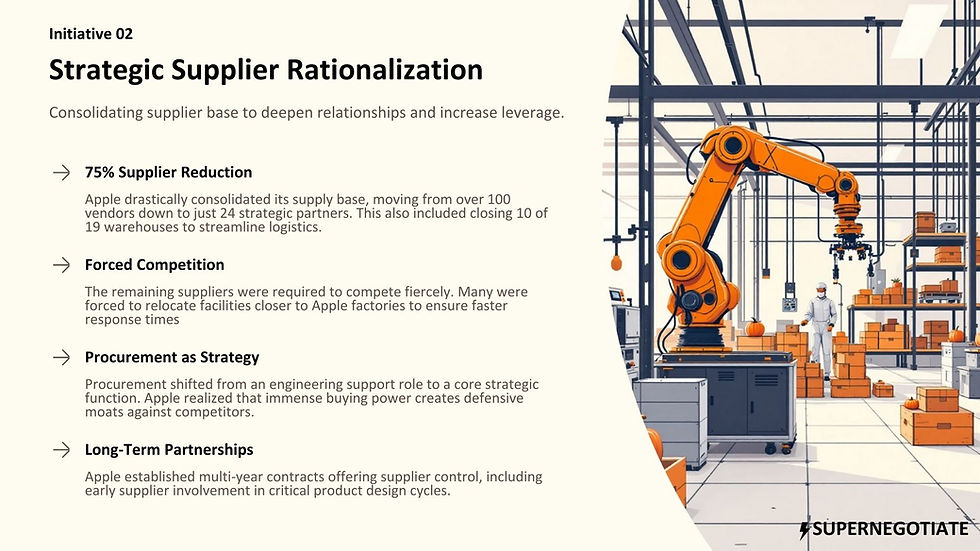
Cook cut down the number of component suppliers from 100 to 24, forcing companies to compete for Apple's business. He also shut down 10 of the 19 Apple warehouses to limit overstocking.
Cook reduced the number of key suppliers by 75% and negotiated even tighter relationships with the remaining winners. He even asked some of them to move closer to other Apple-affiliated factories in order to reduce costs further and align their priorities more completely with Apple's.
Procurement Philosophy:
Tim Cook's approach from the start was to reduce inventory, reduce warehouse space, and force suppliers to compete with one another.
3. Strategic Component Pre-Buying
The Flash Memory Coup (2005):
In 2005, when Apple introduced the iPod Nano, Cook's team accurately predicted tremendous demand and prepaid $1.25 billion to suppliers like Samsung and Hynix to effectively corner the market on a specific kind of flash memory through 2010.
Equipment Exclusivity:
When Apple's designers wanted to install a green light to indicate when a laptop's camera was on, they needed a supply of lasers—each priced at $250,000—to cut the tiny, light-sized holes in the computer's aluminum casing. Cook negotiated an exclusive deal with the supplier and went on to buy hundreds of the lasers, keeping the supplier happily in the black while maintaining Apple's design and supply chain edge.
Impact: This "Buy the Supply" strategy locked competitors out of critical components for years.

4. Contract Manufacturing Transformation (Asset-Light Model)
Outsourcing Strategy:
Almost from the time he showed up at Apple, Cook knew he had to pull the company out of manufacturing. He closed factories and warehouses around the world and instead established relationships with contract manufacturers.
Cook traded lucrative, long-term contracts with manufacturers that gave Apple unprecedented control over the manufacturing process—even in the absence of their direct involvement or exposure in manufacturing.
Key Contract Manufacturers:
Apple maintains suppliers across over 50 countries, with a focus on Asia. The company relies heavily on partners like TSMC for advanced semiconductors, LG Display and Samsung for display panels, and Foxconn and Pegatron for final assembly.
As the principal manufacturer of products and components for Apple, Taiwanese company Foxconn employed 1.4 million China-based workers in 2013.
Financial Result:
Apple was able to capture 58.5 percent of the value of the iPhone, despite the fact that the manufacture of the product is entirely outsourced. Labor costs in China account for the smallest share: 1.8 percent, or nearly US$10, of the US$549 retail price.

5. Hard-Nosed Supplier Negotiations
Iron-Fist Procurement Tactics:
Apple's procurement exec devised and executed a plan that would ultimately deprive chipmaker Qualcomm of some $8 billion in unpaid licensing fees. The executive invited contract manufacturers to the Grand Hyatt Hotel in Taipei and informed the collected suppliers that they no longer needed to pay licensing fees to Qualcomm.
STMicroelectronics lost its place as a supplier of gyroscope parts for the iPhone in 2013 after standing firm during negotiations, costing the company an estimated $150 million in annual revenue.
Apple played a central role in the fall of Imagination Technologies, a UK-based graphics firm. After mulling a buyout, Apple began to poach Imagination employees in 2013, signaling it was working on its own GPU solution. In 2017, Apple informed Imagination that it planned to stop licensing the firm's technology as it shifted work in-house.
Supplier Control Philosophy:
Some Apple veterans were shocked at the priority Cook placed on negotiating supply chain relationships. As a former Engineering VP explained, "When I was there, engineering decided what we wanted, and it was the job of product management and supply management to go get it. It shows a shift in priority."

6. Vertical Integration Through In-House Chip Design
Apple Silicon Initiative:
Apple CEO Tim Cook announced a "two-year transition plan" to Apple silicon on June 22, 2020. The first Macs with Apple-designed chips were released that November; the last Intel Mac was discontinued in June 2023.
Strategic Procurement Benefits:
Apple's shift to custom silicon, such as the M1 and M2 chips, is a prime example of vertical integration. By designing its own processors, Apple no longer relies on Intel, ensuring better optimization for macOS and iOS devices.
By designing its own chips (like the A18 Bionic and M4), Apple reduces reliance on Intel or Qualcomm, enabling optimized performance. During the 2022 chip shortage, Apple's in-house silicon and exclusive TSMC supply helped avoid major delays.
Supplier Partnership:
A $600 billion investment plan over four years, announced in 2025, targets U.S. semiconductor manufacturing and local supplier partnerships. This includes collaborations with TSMC in Arizona, projected to produce over 19 billion chips by 2025.

7. Geographic Supply Chain Diversification (China-Plus-One Strategy)
India Manufacturing Buildout:
Apple assembled $22 billion worth of iPhones in India in the 12 months ended March 2025, increasing production by nearly 60% over the previous year. About 20% of iPhones are now made in India.
India's contribution to total U.S. iPhone shipments surged to 71 percent in Q2 2025, up from just 31 percent a year earlier.
Multi-Country Sourcing:
Tim Cook stated: "For June 2025, we expect the majority of iPhones sold in the US will have India as their origin, and Vietnam for almost all iPad, Mac, Apple Watch, and AirPods." He elaborated: "We learned some time ago that having everything in one location had too much risk with it, and so we have opened up new sources of supply over time."
Contract Manufacturing Partners in India:
Tata Electronics acquired Wistron's iPhone facility in Karnataka's Narsapura for $125 million, contributing approximately 26% of India's total iPhone output. Foxconn has invested over $1.5 billion in India.

8. Supplier Responsibility & Ethical Sourcing Programs
Supply Chain Accountability:
In 2023, over 94% of Apple's suppliers met the company's high standards. Apple audits 100% of its supplier factories annually. Suppliers that violate ethical labor standards risk termination.
Apple demands conflict-free sourcing of cobalt, tungsten, tin, and gold—essential components. Apple works with NGOs, third-party auditors, and local governments to improve labor standards and increase traceability of materials.
Cook's Commitment:
"We care about every worker in our worldwide supply chain. Any accident is deeply troubling, and any issue with working conditions is cause for concern. What we will not do—and never have done—is stand still or turn a blind eye to problems in our supply chain. On this, you have my word." — Tim Cook

9. Carbon Neutral Supply Chain by 2030
Procurement Sustainability Requirements:
300 suppliers have committed to using 100% clean energy by 2030 when manufacturing for Apple
Apple plans to reduce emissions by 75 percent by 2030 while developing innovative carbon removal solutions for the remaining 25 percent.
Apple has reduced its CO₂ emissions by 60% since 2015. The company requires suppliers to use 100% renewable energy for Apple production.
Supplier Sustainability Screening:
Apple says that any company hoping to become a supplier has to commit to be "100% renewable for their Apple production" within 10 years.
10. Supply Chain Crisis Management & Resilience
COVID-19 Response:
His adept handling of the COVID-19 pandemic, including transitioning to remote work and managing product launches, underscores his strategic leadership.
Chip Shortage Navigation (2020-2022):
Apple pre-bought supply capacity from chip manufacturers, shifted production from China to Vietnam and India, and accelerated the redesign of products using more readily available components. By proactively redesigning boards and switching to new suppliers, Apple avoided the long backlogs that plagued its competitors.
Tariff Management:
With tariffs potentially adding an expected $900 million to June 2025 quarter costs, Apple's CFO expressed confidence: "Our March quarter performance drove EPS growth of 8% and $24 billion in operating cash flow." Apple maintained gross margins between 45.5% and 46.5% despite tariff costs.
The Real Impact of Tim Cook's playbook
Metric | Before Cook (1998) | Under Cook (2025) |
Inventory Days | 30 days | 5-6 days |
Inventory Value | $400 million | $78 million (7 months later) |
Suppliers | 100+ | 24 strategic partners |
Warehouses | 19 | 9 |
Revenue | $108 billion (2011) | $416 billion (2025) |
Market Cap | $350 billion (2011) | $3.4 trillion (2025) |
iPhone Manufacturing Countries | 1 (China) | 3+ (China, India, Vietnam) |
Green Energy Committed Suppliers | 0 | 300+ |
Supply Chain Ranking (Gartner) | Unranked | #1 in the World |

Subscribe to my newsletter: mondays.supernegotiate.com
Follow me on linkedin: https://www.linkedin.com/in/supernegotiate/
Support my work here: https://buymeacoffee.com/supernegotiate


Comments